 jovan-pratama
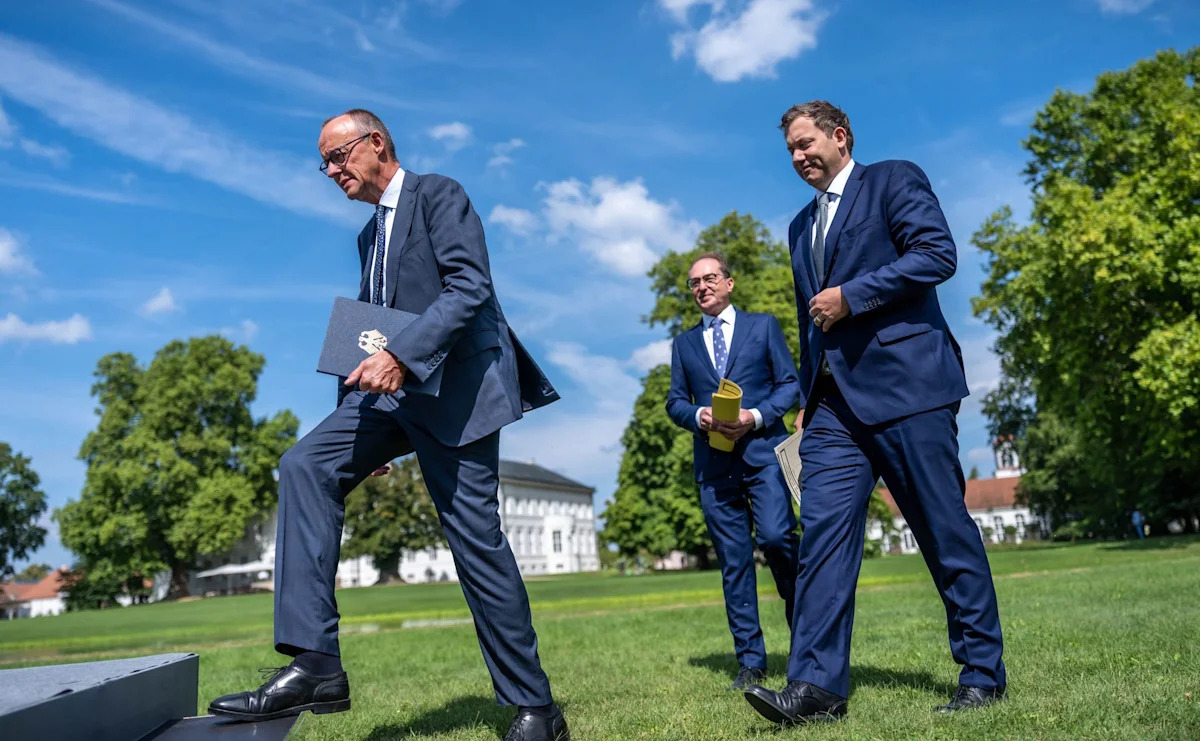
BERLIN — Chancellor Friedrich Merz declared on Wednesday that Germany's prolonged economic downturn has finally run its course, announcing that Europe's largest economy has returned to growth after three consecutive years of contraction and pledging that his government will devote itself entirely to keeping the recovery alive.
The conservative leader delivered his upbeat assessment at the close of a two-day cabinet retreat held at Neuhardenberg Castle in the state of Brandenburg, just outside the capital. He appeared before reporters flanked by Finance Minister and Vice-Chancellor Lars Klingbeil and Interior Minister Alexander Dobrindt following the government's closed-door sessions.
"We have three years of recession behind us and now we are growing again," Merz said, adding that his administration's watchword going forward would be "full concentration on growth."
The chancellor worked hard to project momentum heading into the final stretch of the year, saying his cabinet was entering the remaining months of 2026 with both drive and considerable confidence. By year's end, he argued, the government would be able to present a track record that speaks for itself: a country lifted out of recession, out of economic weakness, and out of the dissatisfaction and distrust of recent years, and steered instead toward a new sense of optimism.
Even so, significant challenges remain. Germany has weathered an extended period of feeble performance, and the aftershocks of the Iran war — including sharp increases in the prices of oil and natural gas — continue to weigh on activity. Economists still expect only minimal expansion for 2026 as a whole, underscoring how narrow the path back to robust growth may be.
Recent data, however, have bolstered the case for optimism. The Federal Statistical Office calculated that gross domestic product grew by 0.3 percent in the April-to-June period compared with the previous quarter, an upward revision of 0.1 percentage point from its initial estimate. Notably, the expansion was achieved despite setbacks tied to the conflict in the Middle East during the spring.
Business sentiment has been moving in the same direction. The ifo business climate index, a closely watched barometer of corporate mood, rose again in August, marking a further improvement in how German firms view their prospects. Merz himself pointed to the multiplying signs in recent weeks and months that the economic situation is gradually turning around.
Innovation and competitiveness formed the centerpiece of the discussions at Neuhardenberg, according to the chancellor, who cast the retreat as an attempt to convert the fledgling upswing into lasting, structural gains for the German economy.
Artificial intelligence figured prominently in those deliberations. Merz highlighted the technology's potential deployment across a wide sweep of the economy — whether in industry, the skilled trades, small and medium-sized businesses, defense or medicine — and insisted that Germany holds "unexpectedly great opportunities" in the field, positioning it as a pillar of the country's future competitiveness.
For a chancellor who has staked his tenure on restoring Germany's reputation as an economic engine, the declaration marks a symbolic milestone after years in which stagnation, industrial malaise and public gloom dominated the debate. Whether the early signs of recovery can be sustained through year-end and beyond remains the central test, but Merz made clear he intends to spend the remainder of 2026 pressing ahead on growth — confident that the record his government compiles will vindicate the turnaround he now says is underway.





Comments (0)